

| 12:24 |
| Skill peaks. Self compounds. |
| · · · |
| “Wherever you are, be all there.” |
| — Jim Elliot |
| · · · |
In high school, before every game, I'd watch a Michael Jordan video, either Come Fly with Me or Michael Jordan's Playground. I was trying to channel MJ: his confidence, his game, and enough of his energy to get me hyped up for tip-off.
The dunks and moves were great, but the moments every kid lived for were the game winners. In real life, those moments are few and far between. I didn't have many in my high school career, but I had one against Bloomington North.
I don't remember where they were ranked, but they were one of the top teams in the state, led by future NBA player Jared Jeffries. Late in regulation, we were down a bucket, and with the clock winding down, my number was called. I took a couple of dribbles from the wing toward the middle of the floor, stepped into my defender, then stepped back (long before the step back was everywhere), pulled up, and hit the shot to send the game to overtime.

It wasn’t quite this pretty.
I don't remember the exact score. We lost in overtime, but that‘s not what stuck with me. What I remember is how I felt going into that last play: excited and confident. No nerves. No fear. I can't say I knew the shot was going to go in, but I wasn't afraid to take it.
And it wasn't like it was a hot night for me. I was having a decent game, nothing like the 7-for-7 night against Earlham I wrote about in “Tip-Off”. The confidence didn't come from the stat sheet; it came from being completely in that moment.
I didn't have words for it then, and I couldn't have told you how to get back there. Now I know what it was: a mindset I'd built, and the presence to stay in that one play.
That's what this issue is all about.
If this issue speaks to you, check out the 12:24 YouTube channel I launched last week. I moved all the MNDFL Monday talks (Mindset, Mindfulness, and Meditation) to the new channel and will record more videos to complement the essays.

|
Issue 002 · The Scouting Report What separates good from great. At every level, the skill gap shrinks, and the mind starts deciding who keeps climbing. We'll define mindset, look at what works against it, and see why confidence is something you build, not something you're born with. Doing and being. Mindset is the doing. Mindfulness is the being. Fear lives in the past and the future, so staying present is how you protect everything you've built, and how you find the zone more often. Where your feet are. I'll share the practice I use to stay present: meditation, journaling, and movement, plus a few simple tools to bring you back to the current play when the game speeds up. |
This summer, Lionel Messi stood over a penalty kick in the World Cup and missed. Not long after, he scored, anyway, and the goal put his name in the record books.
Think about what had to happen in between the two shots. The greatest player of his generation had just failed in front of the whole world. The miss was on the scoreboard, on every replay, and almost certainly in his head. And then, it wasn’t. He let it go and gave everything he had to the play in front of him.
The gap between the miss and the goal is what this issue is about.
When I give a talk to young athletes, I start by asking a simple question and filling a whiteboard with the answers: What separates great from good? The answers come fast. Work ethic. Talent. Size. Speed. Coaching. All are true. But almost every room eventually gets to the same place, even if they don’t have the words for it yet.
The mind.
| 01 — |
| Creating Separation. |
Here's the math every athlete eventually runs into. According to the NCAA's latest numbers, about 3.6% of high school boys' basketball players go on to play college basketball at any level—only about 1% play Division I. In football, it's about 8%. In soccer, roughly 6% of boys and 8% of girls. Then the funnel narrows again: about 1 in 100 draft-eligible college basketball players hear their name called on draft night.
At every level of that funnel, the skill gap shrinks. By the time you're in a college gym, everyone can shoot. Everyone is fast. Everyone has been the best player on their team. When talent evens out, something else decides who keeps climbing. Skill peaks. Self compounds.
That something else is mindset.
A mindset is a set of deeply ingrained beliefs, attitudes, and thought patterns that shape how you see your world and your Self. It's the story running underneath everything you do: how you prepare, how you respond to a bad call, what you tell yourself at the free-throw line down one with four seconds left.
To better understand mindset, it might help to separate two things we usually lump together: your brain and your mind.
Your brain is the organ, the hardware. Your mind is what that hardware does: your thoughts, your emotions, your conscious experience. You don't get to choose your brain, but you do get a say in your mind. You can either control it, or you let others control it for you: coaches, fans, your phone, the comment section, or even your opponent.
One of the best examples of mindset's power is Kobe Bryant and his Mamba Mentality. You don’t need to adopt his mindset, but you can appreciate what a controlled and strong mindset can do for you on the court and in life.

Earlier, you saw the percentages and how the funnel shrinks in size the further you advance in your athletic career. Your dreams and aspirations are achievable, but you won’t reach them without the right mindset. You cannot achieve what you don't believe, so your mind can be your greatest ally or your worst enemy.
Take an honest look. What is your mindset right now? Is it positive? Negative? Confident? Do you even know?
| "Your mind can be your greatest ally or your worst enemy." |
F.E.A.R.
One of the biggest threats to your mindset is fear. Fear of missing. Fear of losing your spot. Fear of letting people down. Fear of finding out you aren't as good as you hoped.
Over the years, I’ve come across two acronyms for fear that I really like—they both spell out what fear really is and how we should approach it. The first is False Evidence Appearing Real. Most of what we fear hasn't happened. It's a prediction your mind makes and then treats like a fact. The second is Face Everything And Rise. Same four letters, opposite response, and directing fear in a positive direction, not negative, where it usually takes us.
When you look at fear through those two lenses and really think about the worst thing that can happen if you miss a shot or turn the ball over, you realize there’s nothing to fear. You’ll still be alive. You’ll get another chance. You’ll still be loved.
Fear is going to show up. It always does. On that last possession against Bloomington North, it just didn’t have anywhere to stand. I wasn’t replaying a miss. I was right there. Face Everything And Rise doesn’t mean you never feel fear; it means you don’t let it make the decision.
Confidence Is Built
The antidote to fear isn't hype. It's confidence, and confidence is a feeling of trust and certainty in your own abilities.
Here's the part most athletes miss: confidence isn't something you have or don't have. It's something you build. Confidence comes from preparation. It's the thousand shots nobody watched. It's the film you studied when you could have been scrolling. That's what Kobe meant by the Mamba Mentality. The work done in private is what lets you trust yourself in public.
If you’re lacking confidence, it might be a sign from your subconscious that you aren’t preparing and training as much as you should.
When you've done the work, a miss is just information. When you haven't, it’s evidence against you.
Doing and Being
Mindset is doing. Mindfulness is being.
If you remember one line from this issue, make it that one. Mindset is the work: the beliefs you build, the preparation, the self-talk. Mindfulness is what keeps that work from getting hijacked in the moment.
Here's why you need both. Look at where fear actually lives.
Past (Fear) → Present (No Fear) → Future (Fear)
Fear lives in the past: I missed my last three. Coach benched me last week. I choked in this gym before. Fear lives in the future: What if I miss? What if they take me out? What if the scout is watching?
But in the present, the actual moment, the ball in your hands, there is no fear. There's just the next thing to do. Fear needs a story about what happened or what might happen. The present doesn't give it one.
That's the whole case for mindfulness in sport. You can build the strongest mindset in the world, but if your mind keeps drifting to the last mistake or the next consequence, fear walks right back in. Staying present is how you protect everything you built.
| "Mindset is doing. Mindfulness is being." |
| 02 — |
| Slowing Down The Game. |
Mindfulness gets a soft reputation, as if it's only candles and quiet rooms. In sport, it's the opposite. It's one of the hardest skills there is.
Mindfulness is the ability to be fully present: aware of where you are and what you're doing, without being overly reactive or overwhelmed by what's happening around you, and without judgment. My shorthand is simpler: be where your feet are.
The Buddhist teacher Thich Nhat Hanh said, "The present moment is the only time over which we have dominion." You can't control the last possession or the final score. You can only control this one.
Flow
You've probably felt what happens when you get this right, even if just once. Athletes call it being in the zone. Researchers call it flow: a state of deep focus, full involvement, and energized enjoyment in what you're doing. It tends to look like this:
Total absorption. Distractions fade, and you feel unified with the game.
Time bends. A quarter flies by, or a single possession seems to slow down.
The inner critic goes quiet. Worry, doubt, and self-judgment disappear.
You just know. The next action is obvious, moment to moment.
No thought. You aren’t thinking about playing. You’re just playing.
Most athletes treat flow like weather. Some nights it shows up; most nights it doesn't, and they do nothing to make it more likely.
But look at that list again. Every item is a description of being present. Flow isn't luck. It's what presence feels like at full speed, and presence can be trained.
| "The present moment is the only time over which we have dominion." |
This week, Calgary Flames goalie Devin Cooley gave a great description of flow in a game:

What Pulls You Out Of Being Present
If flow is found in presence, anything that drags your attention to the past or future breaks it. The scoreboard. The crowd. The ref. The turnover two possessions ago. Your stat line. Wondering who's in the stands. And, before the game ever starts, the phone, which trains your mind all day to jump from one thing to the next.
You’ll never get rid of all of them. The scoreboard isn’t going anywhere, and neither is the crowd. The skill isn’t blocking distractions out. It’s noticing when one has pulled you away, and then returning to the present. Every time you do is a rep—come back to where your feet are, and you’re back in the play.
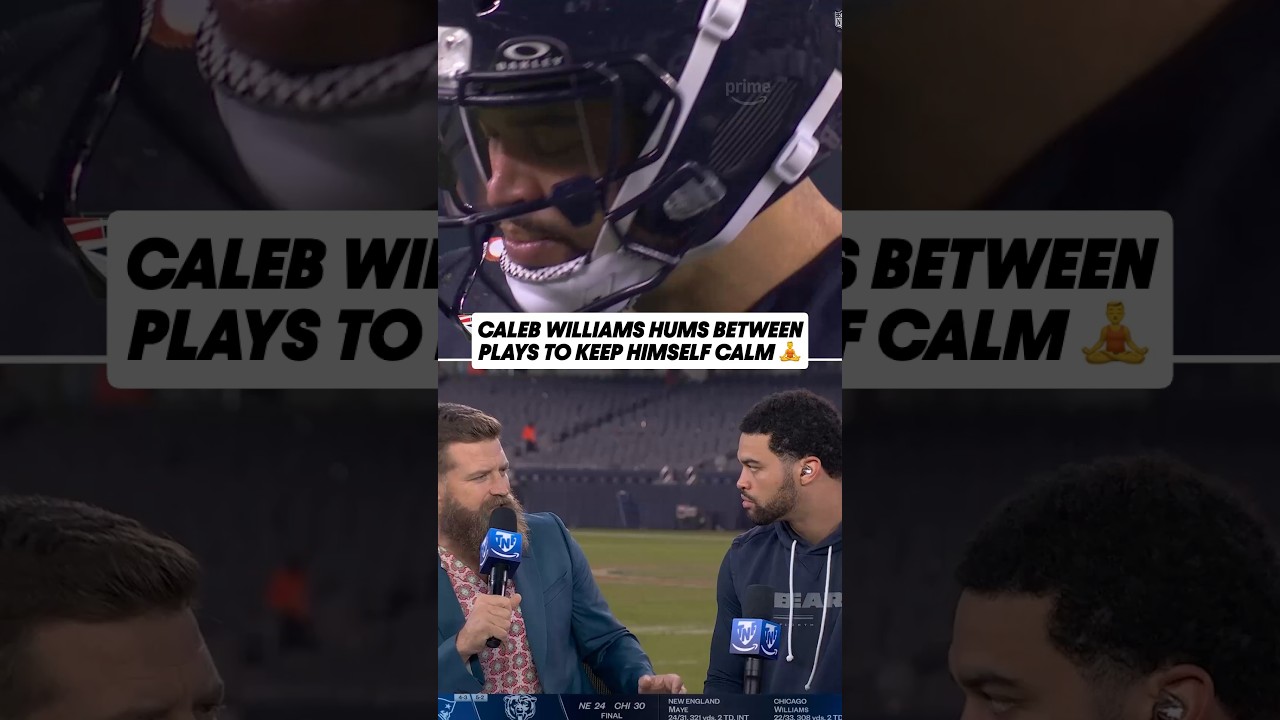
Caleb Williams of the Chicago Bears uses humming to return to his feet as he shares here:
More Than Performance
I've talked about this in terms of the game, but it doesn't stop at the sideline. The same skill that keeps you composed at the line keeps you composed in a hard conversation, in the classroom, in a contract negotiation, in the day your career ends. Presence on the court is practice for presence in life. That's where the Authentic Life gets built.
So how do you train presence?
The same way you train for your sport: with reps, away from the lights, long before anyone is watching you.
| 03 — |
| The Pre-Game Routine. |
When I speak to athletes, I tell them up front: everything I share, I do myself, in ways that work for me. You don't have to do it my way, but to get you started, here's my way—find your way.
Before the Game: My Practice
My playing days are over, but I treat each day as game day. My practice has three parts:
Meditation. I meditate for at least twenty minutes once a day, and lately it’s been so helpful that I’m adding a second sitting. Sometimes I’ll use a guided meditation from the Open app, but most days I sit in silence and focus on my breath. I keep it simple. The more complicated I made it in the past, the harder it was to sit.
Remember the reps? This is where you get them. You sit, your mind drifts, you notice, you come back. That's the exact skill you need when your mind wanders to the last turnover in the middle of a game.
Journaling. For a long time I struggled to journal because I didn’t know how to do it “right”, as if there is a right way to write down your thoughts. Some days I write in a notebook about whatever’s on my mind. Other days my Daily Note is my journal since those are almost always notes I’m writing to my Self that I share publicly.
When something is weighing on me, I make it my intention to write about it; writing gets the noise out of my head and onto paper, where I can actually look at it. Fear loses a lot of its power once you see it written down.
Movement. Mostly yoga, and weight training too. Yoga is mindfulness with your body: the breath, the balance, the posture you can't hold if your mind is somewhere else. And lifting does it in its own way. When there's real weight on your back, you can't be thinking about yesterday—you're right there with the bar.
None of this is complicated. The power comes from doing it consistently, the same way you'd treat ball-handling or film.
Looking back, those Michael Jordan tapes before every high school game were my first pre-game routine. I was visualizing before I knew the word.
In the Game
Preparation builds the capacity. These are the moves you make in real time:
Observe. Notice what's happening, including what's happening inside you.
Don't judge it. A miss is a miss. Don't attach a story to it about what it means.
Breathe. One slow breath brings your body back to the present faster than any thought will.
Next play. Let it go. The last possession is over.
Come back. Every time your mind drifts, return to where your feet are.
Start This Week
Pick one:
A single breath before every free throw.
Five minutes of sitting still before you pick up your phone in the morning.
One line in a journal after practice: what happened, and how you responded.
Start small and stay consistent.
So, what separates good from great?
At the top, it isn't the skill. Everyone there has the skill. It's the mind: a mindset built through preparation, and the presence to keep that mindset from being stolen by the past or the future.
Messi missed. Then he let it go and played this play. That's the whole lesson in one moment.
That game against Bloomington North is long over. So is my career. But this moment isn’t, and neither is yours. Whatever is in front of you right now, whether it’s a practice, a test, or a hard conversation, that’s this play.
Wherever you are, be all there.
🔌 The Plug… Earlier this year, I started researching people who inspire me to build a multi-dimensional business. I used Claude to source articles and put together case studies on each person. I didn’t know that these case studies would be something I’d share. This week I was watching a Chris Brickley interview and thought about the case study I did on him—focusing on his basketball career and how he has built a business around his Self that has never been done before. And then a lightbulb went off: I should share the case studies on 12:24. In future issues, I’m going to be diving into the business of sports and the business of YOU, which will make these case studies all the more valuable. You can learn from Chris Brickley’s blueprint and then apply it in an authentic way to your Self. You can find the first “Film Room” project on Beehiiv now, and you can access it for free by clicking the link below. I’m really proud of how it turned out and I know it’s going to be helpful for readers. Just to tease a few of the upcoming “Film Rooms”, you can expect reports on Larry June, Russ, and Nipsey Hussle. I have a longer list of case studies to build, but those are already complete and waiting to be brought to 12:24. Film Room No.001: Chris Brickley. |
📓 From My Notebook… All of this writing about basketball has me jonesing to play again. Apart from a couple of runs this past summer, I haven’t played regularly or in a league in years. Maybe ten. One reason is fear of an injury, specifically a torn Achilles. Watching the recent run of NBA players, all younger than me, tear theirs hasn’t helped. I can’t help thinking a forty-four-year-old like me is more likely to go down than a twenty- or thirty-something pro. I haven’t introduced you to the law of attraction yet, but as long as that fear is in my head, I don’t want to do anything on the court beyond shooting around. So, just like I wrote about in this issue, I’m going to face it: live in the present instead of in an injury that probably won’t happen. I’ll keep up the yoga for mobility and the lifting for strength, and add skill work, like ball handling, shooting drills and conditioning. You might catch me running suicides at the Fishers Community Center this fall. The goal is to get back to playing, whether that’s open runs at the FCC or an actual men’s league. Next summer, I want to hop into the FCC runs with my son Roman and his teammates. And when I’m traveling, I’d love to meet up with 12:24 readers for a run or to get some shots up. Creating 12:24 has been a lot of fun, and this has been my favorite writing of the last eleven years. It’s fed my inner Creator. I didn’t expect it to wake up my inner Hooper, too. |
That's it for 12:24 #002. If something here speaks to you, just reply. I read and respond to every one. Keep Pursuing, |
